For years, Salesforce was mainly known as the company behind one of the world’s biggest customer relationship management platforms. But in 2026, the Salesforce story is becoming much bigger than traditional CRM.
The company is now pushing aggressively into agentic AI, where software does more than answer questions. AI agents can understand a task, work with business data, use connected tools and complete multiple steps on behalf of employees or customers.
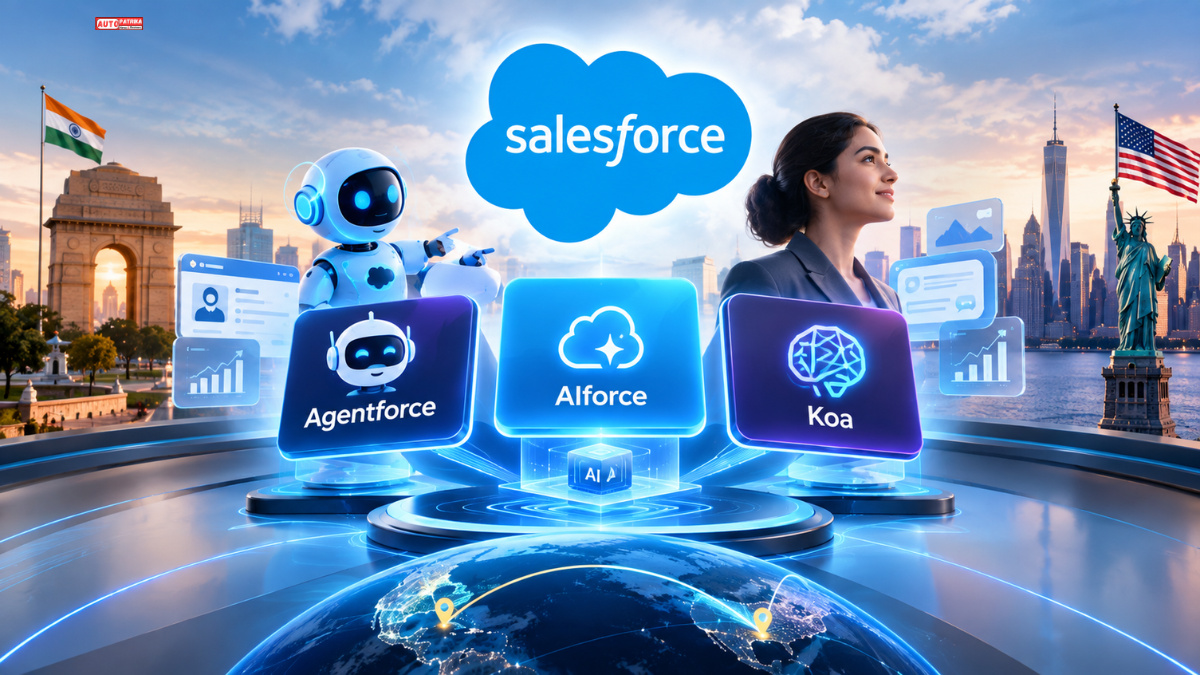
The biggest shift became clear at Dreamforce 2026, where Salesforce introduced AIforce, expanded Agentforce with new job-ready AI agents and announced Koa, its first CRM reasoning model developed with NVIDIA.
For businesses in the US and India, this could change how customer service, sales, marketing and back-office work is handled.
What Is Salesforce?
Salesforce is a cloud-based enterprise software company best known for CRM, or customer relationship management.
In simple terms, Salesforce helps companies keep track of customers, leads, sales opportunities, service requests, marketing activity and other business information in one connected environment.
But modern Salesforce is no longer just about storing customer information.
Its platform increasingly combines CRM data, automation, analytics, AI and digital agents. The company’s current strategy is built around allowing AI to work with business information while following the company’s existing permissions, workflows and security rules.
That is where Agentforce and AIforce come into the picture.
Salesforce Agentforce: The AI Agent Push
Agentforce is Salesforce platform for deploying AI agents that can perform business tasks.
The important difference between a conventional chatbot and an AI agent is what happens after the conversation begins.
A chatbot may answer a question. An agent can potentially understand the goal, access relevant information, call the required tools and take action.
Salesforce has been expanding Agentforce so that agents can handle increasingly complex work across sales, customer service, commerce, employee support and back-office operations.
At Dreamforce 2026, Salesforce announced a new portfolio of job-ready agents designed for specific business functions. These include Casey for customer service, Paige for IT and HR service, Carter for shopping, Hunter for outbound sales, Marshall for supply-chain work and Piper for inbound lead generation.
Salesforce says the newer Agentforce technology is designed to let agents pursue goals over longer periods, learn new skills, collaborate with other agents and continuously improve.
That is a significant change from the traditional idea of an AI assistant that simply responds to a prompt.
What Is Salesforce AIforce?
One of the biggest announcements from Dreamforce 2026 was AIforce.
Salesforce describes AIforce as a live interface layer that can bring Salesforce data, workflows, business logic, permissions, security and governance into different AI interfaces.
The idea is relatively simple: employees should not necessarily have to open a traditional CRM screen every time they want to use business information.
Instead, Salesforc wants its platform to work wherever people and AI agents are already working.
This could become important as companies increasingly use multiple AI tools instead of relying on a single application.
For businesses, the attraction is having AI interact with existing enterprise data without completely rebuilding the underlying systems.
Koa: Salesforce’s New CRM Reasoning Model
Another major Salesforc announcement in September 2026 was Koa, the company’s first CRM reasoning model.
Salesforce developed Koa in collaboration with NVIDIA using NVIDIA Nemotron technology.
According to Salesforce, Koa was designed specifically for CRM-related reasoning and complex, multi-step business workflows. The company says it was trained using synthetic scenarios representing enterprise CRM tasks rather than customer data.
This distinction matters.
Instead of building a general-purpose AI model and asking it to understand CRM processes from scratch, Salesforce is trying to create a model specifically focused on how business workflows operate.
Salesforce says Koa was trained around scenarios covering more than 14 industries and was designed to understand tasks such as managing opportunities, routing service cases and scheduling follow-ups.
The company also says Koa can match or exceed leading model performance on its CRM benchmark while producing fewer errors on the evaluated CRM actions. These are Salesforce’s own benchmark claims rather than an independent industry evaluation.
Koa is currently available to select pilot customers, with general availability expected in US regions in winter 2026, according to Salesforce.
Salesforce and Air India: Why India Matters
One of the most interesting real-world Salesforc AI developments for Indian readers is the company’s work with Air India.
Air India has expanded its use of Agentforce beyond its initial refund-processing deployment.
Salesforc says the airline is now using Agentforce for automated email resolution, name-change automation and a knowledge assistant for customer-service teams.
The refund example shows why enterprise AI is moving beyond simple chat.
According to Salesfor Agentforce helped Air India reduce its internal refund-processing time from approximately 14 days to around four hours, although bank-processing time remains unchanged.
For name corrections, Salesforc says the turnaround time was reduced from roughly three days to about 30 minutes.
Air India says its cloud-based digital ecosystem spans more than 140 enterprise systems and that it has more than 30 agentic AI initiatives underway.
For India, this is an important example because it shows how AI agents can potentially work across complicated enterprise systems rather than functioning as standalone chatbots.
What Salesforce AI Could Mean for US Businesses
The US remains one of Salesforc biggest enterprise markets, and the company’s latest strategy is closely tied to the broader shift toward AI-powered workplace software.
For American businesses, Agentforce can potentially be used in areas such as:
- Customer support
- Sales follow-ups
- Lead qualification
- Employee help desks
- Marketing operations
- E-commerce assistance
- Supply-chain workflows
- IT support
- Data-driven customer engagement
The larger idea is automation of repetitive multi-step work.
For example, a sales agent could research a prospect, update CRM information, prepare outreach and coordinate follow-up tasks. A service agent could identify a customer’s problem, check account information, retrieve relevant policies and initiate the next workflow.
The exact capabilities depend on the Salesforc products, configuration, permissions and business processes involved.
Salesforce Is Moving Beyond the Traditional CRM Screen
Perhaps the most interesting part of Salesforc 2026 strategy is that the company is questioning the traditional software interface itself.
For decades, employees learned to open an application, navigate menus, search for records and then perform actions.
The AI-first approach turns that process around.
Instead of asking employees to learn every part of a complicated application, companies can increasingly let employees describe what they want to accomplish and allow AI agents to work through the underlying systems.
AIforce is central to that idea because Salesforc wants its data and business logic to be accessible through different interfaces while maintaining permissions, security and governance.
That does not mean traditional Salesforc interfaces disappear overnight. Enterprise systems still need dashboards, reports, administration tools and human oversight.
But the way employees interact with those systems could change significantly.
Salesforce AI and Data Privacy
As AI agents gain the ability to take action, security becomes even more important.
An AI that can only generate text presents one type of risk. An AI that can update customer records, change orders or trigger business processes presents another.
That is why Salesforce is emphasizing permissions, governance and what it calls a trust boundary.
For Koa, Salesforc says customer data was not used to train the model. The company also says it controls the model weights and runs post-training and inference within its own infrastructure.
For enterprises, these details can matter as much as raw AI performance.
Banks, airlines, healthcare companies, government organizations and large corporations often have strict requirements around data access and deployment environments.
Salesforce is also extending its AI strategy into Missionforce for government and regulated organizations, including support for private-cloud and air-gapped environments.
What About Small Businesses?
AI push is not only relevant to giant corporations.
Smaller businesses can potentially benefit from AI agents for customer support, lead management, sales follow-ups and internal workflows.
However, the value depends heavily on the company’s existing systems and how much automation it actually needs.
AI does not automatically fix a poorly organized business process.
Companies still need clean data, clear permissions, good workflows and people who understand where human approval is required.
That means Salesforce’s AI tools are likely to be most useful when they are connected to well-structured business operations.
Salesforce in India vs US
The underlying technology is global, but the use cases can look different.
In India, Air India deployment provides a clear example of AI being connected to large-scale customer service and complex operational systems. The country’s expanding technology sector also creates opportunities for Salesforce’s AI ecosystem, developers and enterprise partners.
In the US, Salesforce’s strategy is closely tied to large enterprise deployments, AI-powered sales and service, government applications and partnerships with major technology companies.
The company is also expanding its relationships with companies including NVIDIA, Google Cloud, AWS and Siemens as it builds a broader AI ecosystem.
Is Salesforce Becoming an AI Company?
Salesforc is still fundamentally a CRM and enterprise software company.
But the direction is clear: AI is becoming deeply embedded across its platform.
Agentforce represents the move toward AI agents.
AIforce represents the move toward AI-native interfaces.
Koa represents Salesforce’s attempt to build specialized reasoning capability for CRM workflows.
Together, these developments show how Salesforce is trying to transform from software that employees operate into software where AI agents can increasingly perform parts of the work.
That transition will take time.
Businesses will need to decide which tasks can safely be automated, which require human approval and how much autonomy an AI agent should receive.
Salesforce 2026: What Happens Next?
The next phase of Salesforc AI strategy will likely be less about impressive demonstrations and more about measurable business results.
Companies will want to know whether AI agents can actually reduce response times, increase sales productivity, lower operating costs and improve customer experiences without creating new security or compliance problems.
Salesforc latest announcements suggest that the company is betting heavily on this model.
With Agentforce, AIforce and Koa, Salesforce is trying to put AI directly into the systems where business decisions and workflows already happen.
For both India and the US, the interesting question is no longer simply whether businesses will use AI.
It is increasingly about how much of the actual work AI agents will be trusted to do.
Salesforce 2026 FAQs
What is Salesforce?
Salesforc is a cloud-based enterprise software company best known for CRM and customer relationship management. Its platform now includes AI, automation, analytics and agentic AI capabilities.
What is Salesforce Agentforc?
Agentforce is Salesforc’s platform for building and deploying AI agents that can assist with or perform business tasks across areas such as sales, customer service and employee support.
What is Salesforce AIforc?
AIforce is a Salesforc interface layer announced at Dreamforce 2026 that is designed to bring Salesforce data, workflows, business logic, permissions and governance into different AI interfaces.
What is Koa in Salesforc?
Koa is Salesforce’s first CRM reasoning model, developed with NVIDIA using NVIDIA Nemotron technology. It is designed for complex, multi-step CRM workflows.
Is Salesforce using AI in India?
Yes. Air India is expanding its use of Salesforce Agentforce for customer-service workflows including email resolution, name-change processing and an AI knowledge assistant.
Can Salesforce AI replace employees?
Salesforc technology is designed to automate or assist with specific tasks and workflows. Whether a business replaces or reduces human work depends on its own deployment decisions, processes and oversight requirements.
Is Koa available to everyone?
Not yet. Salesforce says Koa is available to select pilot customers, with general availability expected in winter 2026 in US regions.
Why is Salesforc working with NVIDIA?
Salesforce and NVIDIA are collaborating on AI models and accelerated computing. Koa uses NVIDIA Nemotron as its foundation, while Salesforce specializes it for CRM reasoning and enterprise workflows.
Is Salesforc only for large companies?
No. Salesforce serves businesses of different sizes, although the complexity and cost of enterprise CRM and AI deployments can vary considerably depending on business needs.
What is the biggest Salesforce trend in 2026?
The biggest shift is Salesforce’s move toward agentic AI, where AI agents can reason through business tasks and take actions within connected enterprise workflows rather than simply generating answers.
Final Take
Salesforc is entering a different phase of its evolution.
The company that became famous for putting CRM in the cloud is now trying to make CRM increasingly AI-native.
Agentforc is giving AI agents more responsibility. AIforce is bringing Salesforce capabilities into new interfaces. Koa is giving the platform a specialized reasoning model for CRM work.
And the Air India deployment shows that this is already moving beyond product demonstrations into real enterprise operations.
For businesses in India and the US, Salesforc next chapter will be worth watching closely because the future of CRM may not be about employees spending more time inside software.
It could be about software doing more of the work itself with humans still deciding where the boundaries should be.
Read More
Samsung One UI 9: Android 17 Update Brings New AI, Privacy and Video Features
iOS 27 Released: New Features, Siri AI, Supported iPhones & Update
Sony PlayStation Store Credit Settlement: Who Gets Paid in 2026?